

Scheduling a Film!?
So much more than production. Some graphical approaches to long-term scheduling.

This week, our FilmStack/NonDé filmmaking friend Courtney Romano posted how she’s scheduling her own upcoming film. She uses an app called Notion which looks very cool and she swears by it. She explained in comments that she likes collaborating with her team using Notion, and prefers it over Google Sheets. But getting everyone on her team to use it is another matter:
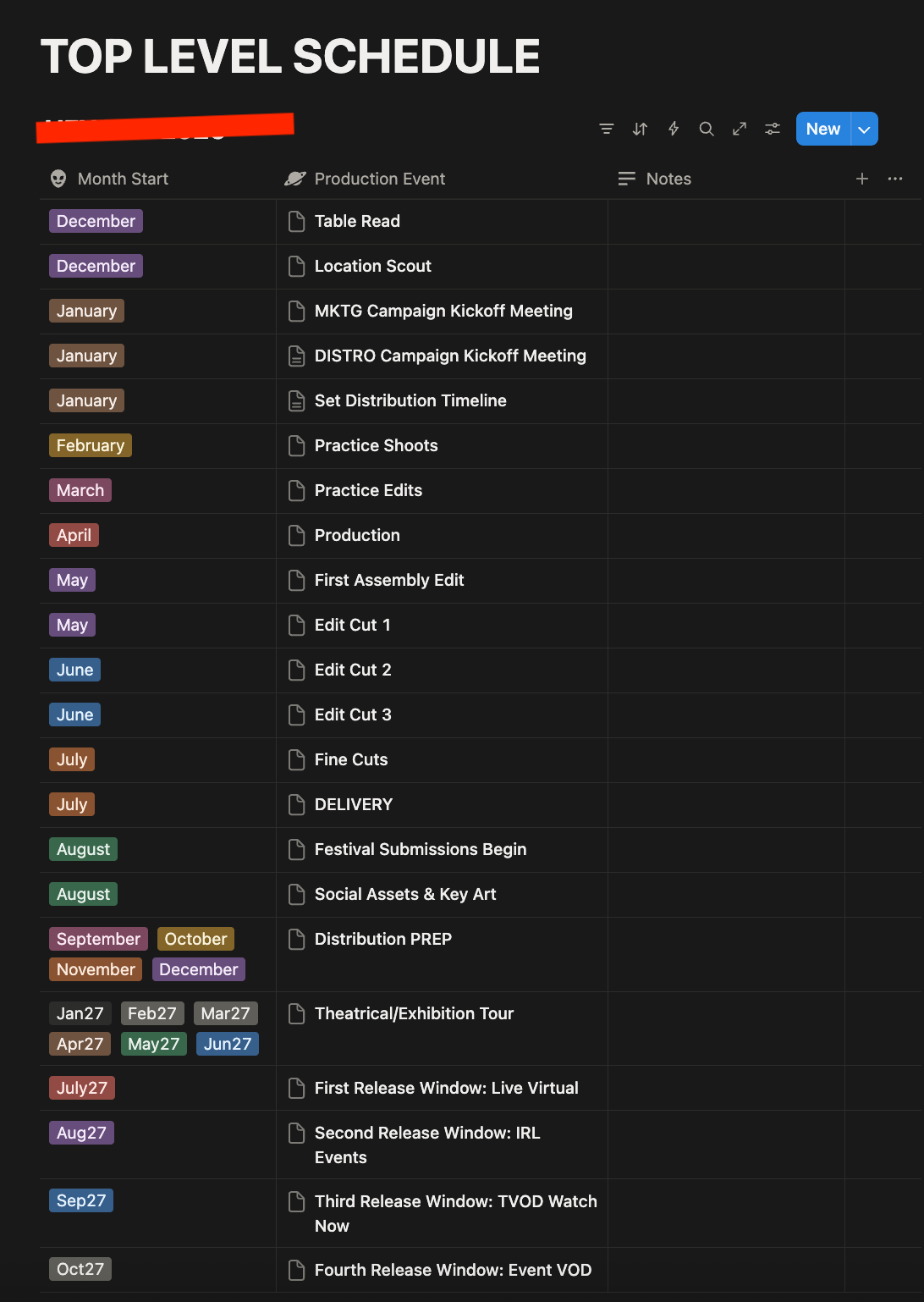
This got me thinking about lower tech versions of how to do a long-term schedule, and perhaps more importantly, what to schedule. My own comments to Courtney as well as many others praised her for her comprehensive and rigorous schedule, as well as being so transparent about sharing it with our FilmStack community. (I blocked our her title in cases she changes her mind about how much transparency she wants lingering on the internets :)
So in my graduate producing class at Chapman University this week, my students and I took advantage of our rolling phalanx of white boards in the room to do something similar. No apps necessary: Just OG huffing dry-erase fumes in a windowless room to get the creative juices flowing! So here’s the long-term schedule we came up with for a (mostly) hypothetical film one of the students has in class:
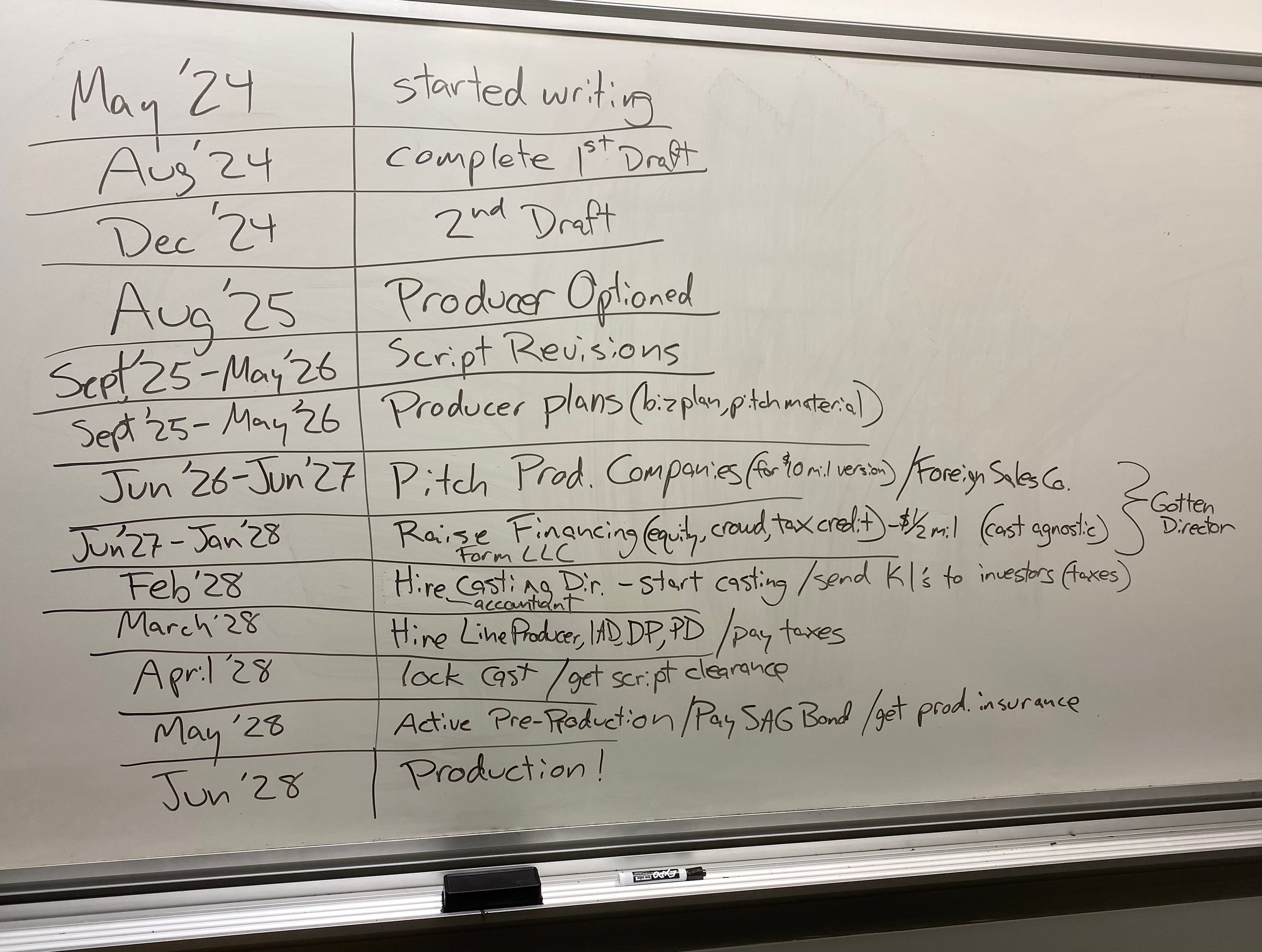
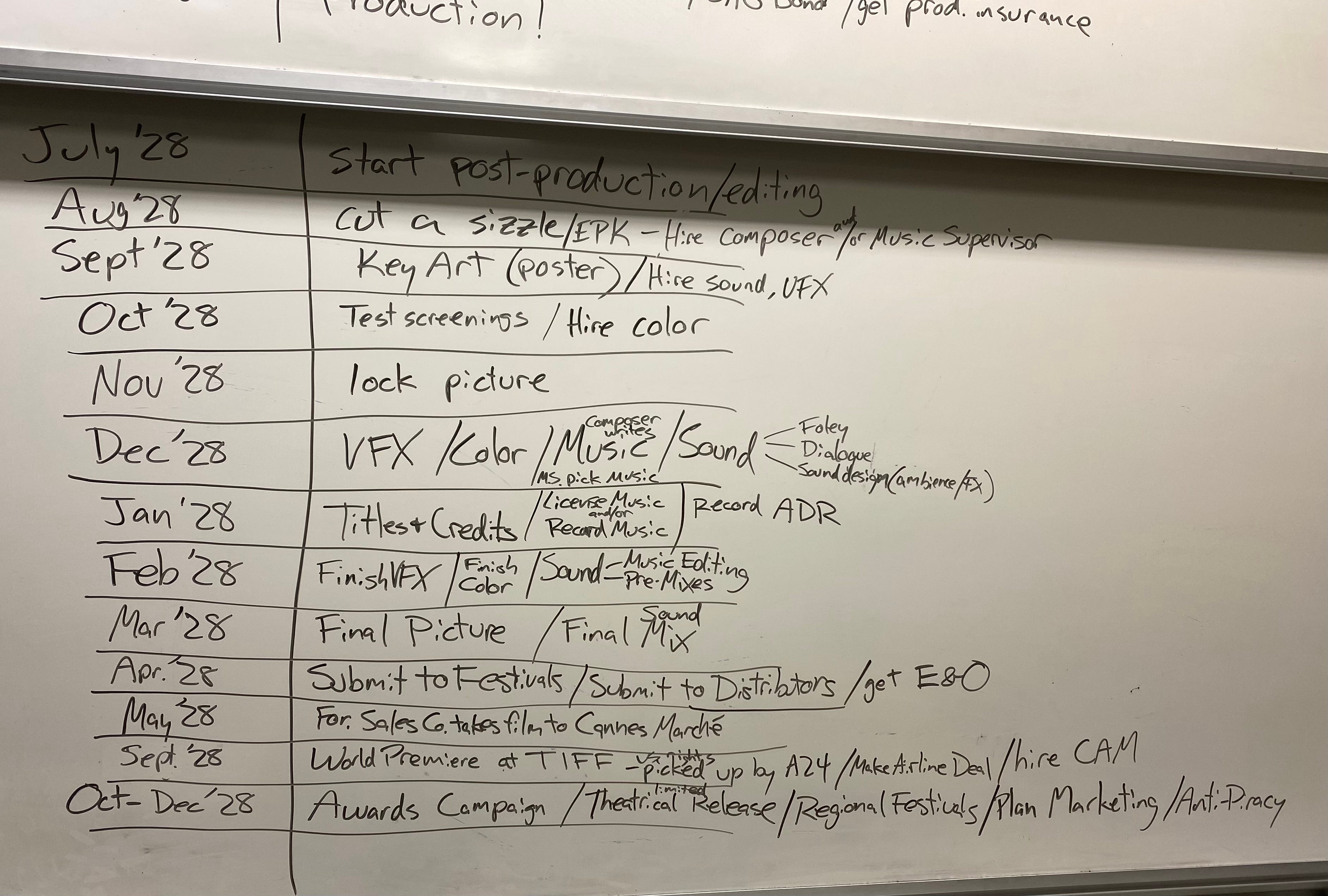
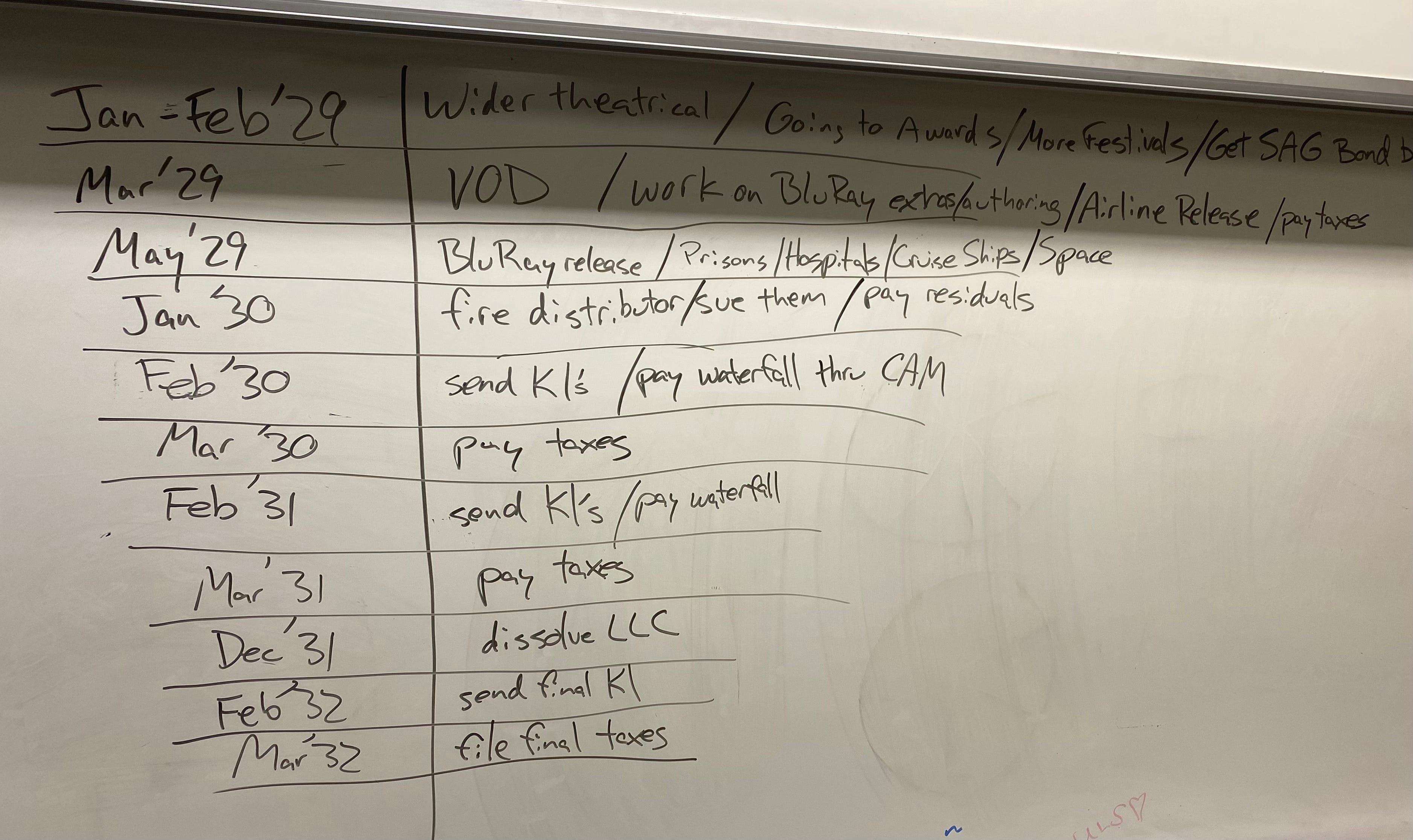
Of course, when you teach film students, they all think their film is going to get picked up by A24. It’s tough to inject complete realism without also crushing their spirits too much. (As faculty, we do want them to come back again next semester.) But I think the real emotional takeaway that a graphical schedule like this does for students and working filmmakers alike is that making a movie takes a LONG TIME!
“Production” - actually shooting the film, is barely one word on one line. It’s a speck in the lifetime of a film. As I posted recently, filmmaking is so much more than just shooting the film itself.
In our little example, from screenwriting to filing final taxes takes at least 8 years. And believe me, if we’d had more white boards, we easily could have extended this schedule another 8-30 years with everything from archiving, getting new distribution, suing that distributor, other IP exploitation (it’s a play! it’s a graphic novel!), re-releasing on some fancy new digital platform (Google contact lenses!), retrospective screenings, tracking down investors’ heirs, securing your own heirs, etc.
And if our white boards had been a little wider, we also would have added another column called “Life” which would have tracked things like marriages, kids, day jobs, real estate, health crises, funerals, etc.
Bottom line? Making a feature film takes a long time. It’s a marathon. It’s a lifestyle. And yes, it’s potentially a life-long commitment. Good luck!!!
Hi Dan, if I was teaching filmmaking, I would incorporate a NonDe approach, throwing most of this out the window to get the process down to less items and less time involved. The ideal would be to get it to between 6 to 18 months. Make the script a Scriptment and make the shoot Cassavetes style. Is SAG/AFTRA in the equation? Not always, especially, if it is your first film. Combine the location and funding, accomplish two items with one solution. Make sure to use an umbrella insurance policy for the production that will be purchased by your NonDe coordinator to be used by all NonDe productions. Do your Teaser. using AI, for almost nothing, to get your project out there early to help build that audience.
Thanks for breaking this out! If one is going to eventually dissolve the LLC that was created for the film, my assumption is that the film would no longer be generating any profit in any form once final taxes are filed and the LLC dissolved? What about the very long tail profit potential (anniversary retrospective, one off screenings, etc) for things that could/would happen years or decades down the line? Transfer to other entity or potentially keep that LLC open (obviously would have to keep paying for that to happen)? Do you think NonDe filmmakers should be thinking of their body of work more like how studios have cultivated their libraries of IP...My assumption is that we would have to figure out how maintain that overhead as well, as well as keep open the opportunity for people to discover it years from its creation...thanks in advance for any thoughts you might have on that!